Overloading the incoming supply
Adding 32A of continuous load to a property with a shower and electric hob and no load assessment risks nuisance operation of the main fuse, an issue for the network operator, not a quick fix.

NICEIC Approved Contractor · Reg 041430
A 7kW home charger fitted properly: supply capacity checked, cable routed neatly, correct protection at the board, tested and certificated. Hypervolt, myenergi Zappi, Ohme and Pod Point approved. Free quote, fixed price agreed in advance, no deposit.
4.8 from 58 Google reviews · OZEV approved · Hypervolt, Zappi, Ohme and Pod Point approved
OZEV approved
Approved installer for home charge points
Four brands approved
Hypervolt, myenergi Zappi, Ohme, Pod Point
NICEIC Approved
Contractor registration 041430
Fixed price, no deposit
Quoted in advance, nothing to pay up front
The service
Installing a home charger is not simply screwing a unit to a wall. It means checking the incoming supply and main fuse, confirming the earthing arrangement is suitable for outdoor charging, running a dedicated circuit from the consumer unit to the charger position, fitting the correct protective device, then commissioning, testing and certificating the installation.
Amara is an OZEV approved installer and an approved installer for Hypervolt, myenergi (Zappi), Ohme and Pod Point. That means the units are installed and commissioned to the manufacturer's requirements, registered where the manufacturer requires it, and set up on the app so load management and tariff scheduling actually work from day one.
Standard home installations are 7kW single-phase, which is the practical maximum for most domestic supplies and adds a usable range overnight on an off-peak tariff. The position of the unit, the cable route and the tethered-versus-untethered choice are agreed with you on the site visit.
Quotes are free and given as a fixed price in advance, with no deposit required. Reviewers who have had chargers fitted mention the same three things: the price was as agreed beforehand, Mike arrived on time, and the place was left neat and tidy.
New EV and plug-in hybrid drivers
Charging from a three-pin socket is slow and was never designed for hours of continuous load. A dedicated 7kW point is the difference between overnight and all weekend.
Drivers on off-peak tariffs
A smart charger scheduled around a cheap overnight rate is where the running-cost saving actually comes from.
Households with solar
Units such as the myenergi Zappi can divert surplus generation into the car rather than exporting it.
Rewire and renovation projects
If the floors are up, running the charger supply now costs a fraction of doing it as a separate job later.
What it costs to leave it
A charge point draws close to its maximum for hours at a time, outdoors, in British weather. It is one of the most demanding circuits in a domestic property, and installation shortcuts show up quickly.
Adding 32A of continuous load to a property with a shower and electric hob and no load assessment risks nuisance operation of the main fuse, an issue for the network operator, not a quick fix.
Charging outside requires the earthing arrangement to be assessed and the correct protection provided. Getting this wrong creates a genuine shock risk during a supply fault.
EV circuits require protection appropriate to DC leakage. Fitting an ordinary device leaves the circuit protection ineffective in exactly the fault it is meant to catch.
A 13A socket run for hours at a time was never designed for that duty and, in older wiring, is a common cause of overheating at the faceplate.
Cable clipped across a wet wall with the wrong fixings, or undersized for the length of the run, causes voltage drop and premature failure.
A charger that was never registered or app-configured cannot schedule off-peak charging, which is where most of the saving lives.
Our process
The incoming supply, main fuse rating, earthing arrangement, consumer unit capacity and the parking position are all assessed before anything is quoted.
Tethered or untethered, which brand and model suits how you charge, exactly where the unit goes and how the cable will be routed.
A free quote given the same day or promptly after the visit, covering the unit, the circuit, any board work needed and the certification. No deposit required.
Dedicated circuit run from the consumer unit, correct protective device fitted, cable clipped and routed neatly, unit mounted securely and weathertight.
Circuit tested to 18th Edition standards, unit commissioned to the manufacturer's requirements, connected to Wi-Fi and set up on the app with your tariff schedule.
You are shown how the unit and app work, the circuit is labelled at the board, and certification is issued for the installation.
What you get
7kW replaces the trickle of a three-pin lead with a charge that is done by morning on a standard domestic supply.
Smart scheduling puts the charging into your off-peak window automatically, which is where the running-cost saving comes from.
The right device for an EV circuit, an earthing arrangement assessed for outdoor use, and a supply capacity check before anything is fitted.
Installed and registered as an approved installer for Hypervolt, myenergi Zappi, Ohme and Pod Point, so the manufacturer cover stands.
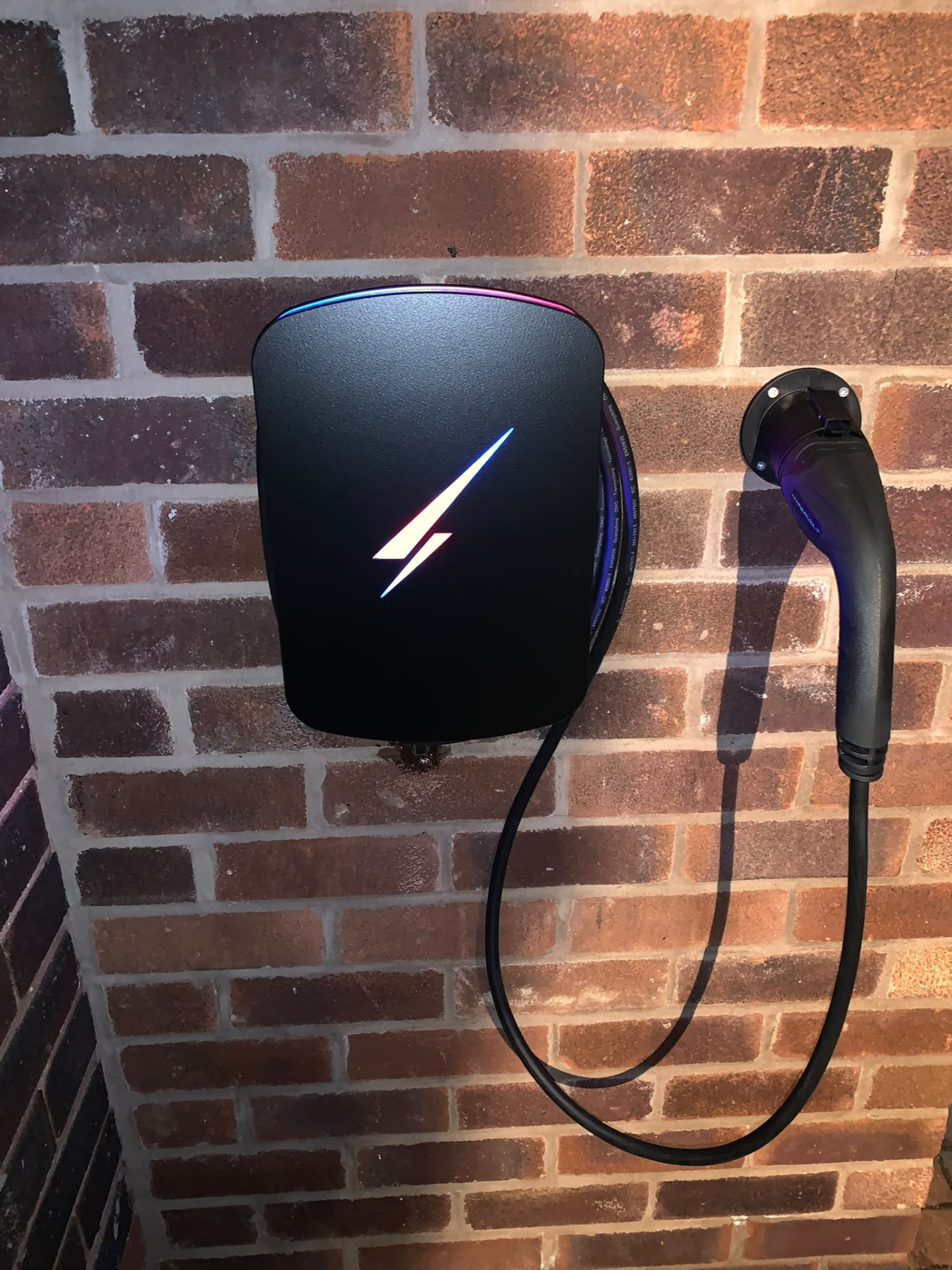
Cable routed sensibly, fixed properly and weatherproofed, not draped across the brickwork. Reviewers mention the neat finish specifically.
Tested and certificated by a NICEIC Approved Contractor with £5,000,000 public liability insurance.
In detail
Most of the difference between a good charger installation and an awkward one is decided before any cable is run: which unit, where it goes, and what the existing installation can support.
Amara is an approved installer for Hypervolt, myenergi (Zappi), Ohme and Pod Point. Each suits a slightly different household: Zappi is the usual choice where there is solar generation to divert, Ohme leans heavily on tariff integration, Hypervolt and Pod Point are strong all-round smart units with solid app control.
If you have already bought a unit, say so when you call. If you have not, Mike will tell you which of them fits how you actually charge rather than which has the longest feature list.
A tethered unit has the cable permanently attached: quicker day to day, and one less thing to carry. An untethered unit takes any Type 2 cable, keeps the wall unit smaller and tidier, and is more flexible if you change cars or lend the point to a visitor.
For most households parking in the same spot every night, tethered wins on convenience. Where the unit is on a front wall in public view, untethered often looks better and leaves nothing hanging.
Before anything is specified, the incoming supply and main fuse rating are checked against the property's existing demand: shower, oven, hob, immersion. Where headroom is limited, load management is used so the charger reduces its draw when the rest of the house is busy rather than putting the main fuse at risk.
Most smart chargers support this natively, and setting it up correctly is part of commissioning rather than an optional extra.
The circuit is run from the consumer unit to the charger by the route that is both electrically sound and visually tidy: through a garage or loft where possible, clipped in straight lines with correct fixings where it has to be surface-run, and sleeved where it passes through the wall.
The unit itself is mounted at a sensible height for the charging port on your car, clear of doors, gates and wheelie bins, and positioned so the cable reaches without stretching across a path.
The charger needs a dedicated way at the consumer unit with the correct protective device. If the existing board is full, or is an older rewireable unit with no RCD protection, a consumer unit upgrade is usually carried out at the same time; it is cheaper combined than as two separate visits.
Where the board is being changed anyway, it is specified with spare capacity so a second charger or another major circuit does not mean starting again.
If you generate your own electricity, a diverting charger will send surplus into the car instead of exporting it at a lower rate. That changes the specification: the unit needs a compatible current transformer clamped on the incoming supply, and the position of that clamp is part of the install.
Where the parking space is not directly attached to the property, a detached garage, a shared drive or a rear parking area, the run length and the routing become the deciding factors, and sometimes a supply to the outbuilding is the sensible first job. These are assessed on the site visit rather than quoted blind.
The work is primarily domestic. Light commercial charge point installation is undertaken on request where the installation is of comparable scale.
EV charger installations are carried out across Congleton and the wider Cheshire area, plus Manchester, Stoke-on-Trent, Stockport, Cheadle, Wilmslow, Altrincham and Crewe.
Where we work
Based in Congleton and covering the surrounding towns. See the full list of areas we cover or get in touch.
Related services
Common questions
Anything not covered here, call Mike on 07946 541693.
It depends on the unit chosen, the length of the cable run and whether any consumer unit work is needed. Quotes are free, given as a fixed price in advance after a site visit, and no deposit is required. Reviewers note the price was as agreed beforehand.
A straightforward 7kW installation is typically completed in a day. Longer cable runs, outbuildings or a consumer unit upgrade at the same time can extend that, and you are told the expected duration when the work is quoted.
Amara is an approved installer for Hypervolt, myenergi (Zappi), Ohme and Pod Point, and is OZEV approved. If you have already bought a unit, mention the make and model when you call.
22kW needs a three-phase supply, which the vast majority of domestic properties do not have. 7kW single-phase is the standard home installation and, on an overnight off-peak schedule, is enough for normal daily driving.
Only if it has no spare capacity or lacks suitable protection. That is checked on the site visit and included in the quote rather than raised as an extra later. Doing both together costs less than two separate visits.
Yes. The circuit is tested to 18th Edition standards and certification is issued on completion. Certain products and components carry a 12-month manufacturer warranty, and the unit is registered with the manufacturer where required.
A quality unit installed and commissioned correctly is a long-term fixture, and manufacturers back their units with their own warranty terms. Keeping the circuit within a periodic inspection cycle, an EICR every five years for rented property, ten for owner-occupied, keeps it documented.
Yes. Call Mike and describe what the unit is showing. Fault-finding call-outs are charged at an hourly rate, quoted before any repair work starts, so you know the basis of the charge before we attend.
Usually, yes. The deciding factors are the cable run length and whether the outbuilding already has an adequate supply. Both are assessed on the free site visit.
Yes, it is the single cheapest time to do it. A dedicated supply run and left ready during a rewire costs far less than opening the property up again later.
Next step
Call Mike with your car, where you park and roughly where the consumer unit is, and he will tell you what is involved. Site visits and quotes are free, the price is fixed in advance and there is no deposit.
07946 541693Mon–Fri 8am–7pm · Sat 9am–3pm
Accredited, approved and independently reviewed