Faults with no visible symptom
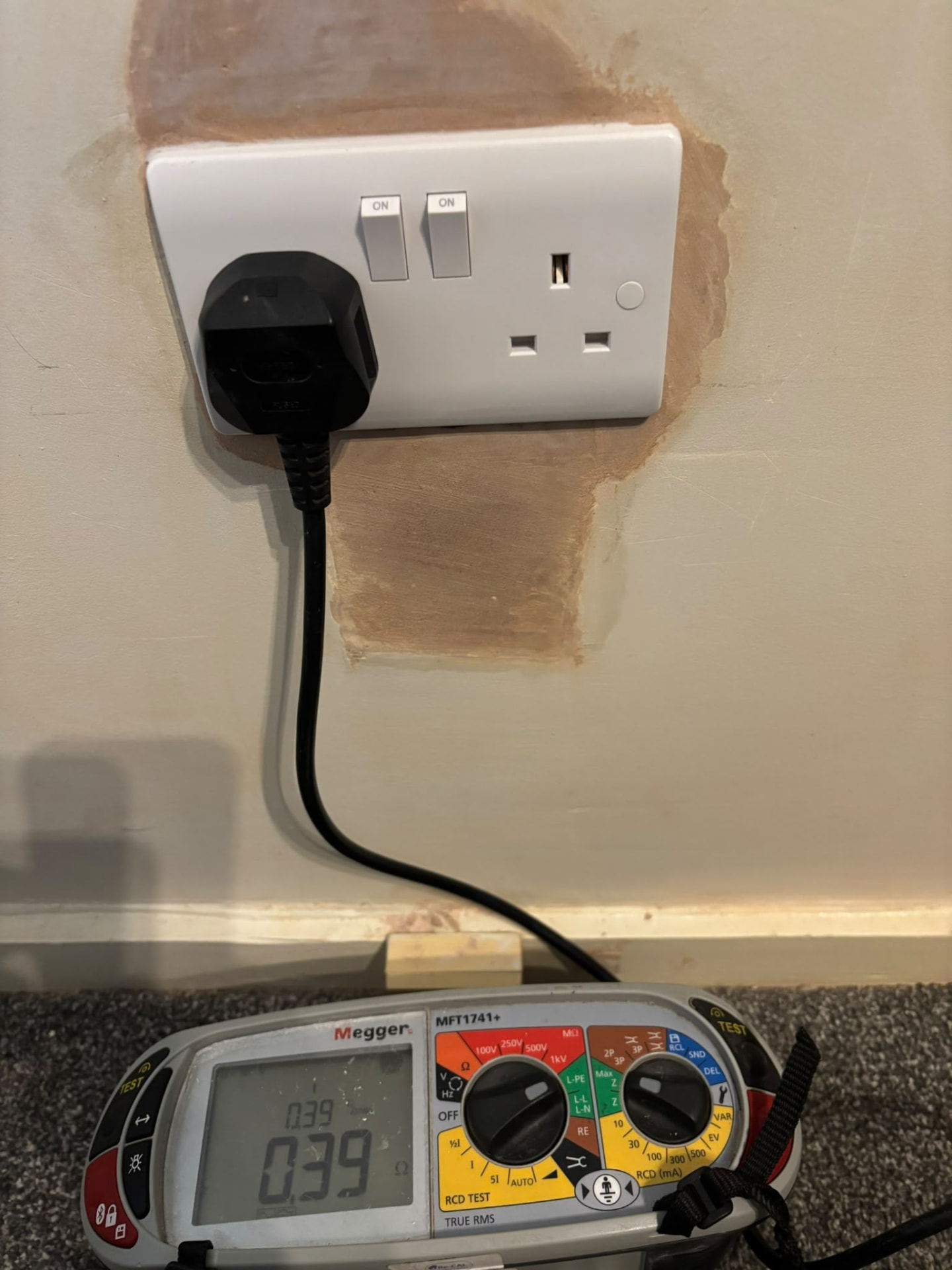
Low insulation resistance, a missing or undersized earth, or a borrowed neutral across circuits are invisible from a faceplate and only show on instrument readings.


NICEIC Approved Contractor · Reg 041430
An Electrical Installation Condition Report tells you exactly what state your wiring is in, which faults are urgent and which are not, and what it would cost to put right. Tested to 18th Edition standards by a City & Guilds 2391 qualified electrician, priced before we attend.
4.8 from 58 Google reviews · City & Guilds 2391 inspection and testing · NICEIC Approved
City & Guilds 2391
The inspection and testing qualification
NICEIC Approved
Contractor registration 041430
38 years in the trade
Qualified electrician since 1988
£5m public liability
Fully insured on every visit
The service
An Electrical Installation Condition Report is a formal inspection and test of the fixed wiring in a property: the consumer unit, every circuit, the earthing and bonding, and a sample of accessories. It is not a visual once-over. Circuits are tested with calibrated instruments for insulation resistance, continuity, polarity, earth fault loop impedance and RCD operation, and the readings are recorded.
The report comes back either satisfactory or unsatisfactory, with any issues coded. C1 means danger present and requires immediate action. C2 means potentially dangerous and requires remedial work. C3 is an improvement recommendation and does not make a report unsatisfactory. FI means further investigation is required. Those codes decide what has to be done and how quickly.
Mike goes through the findings with you rather than emailing a PDF full of codes and leaving you to decode it. You get told what was found, which items matter, what happens if they are left, and what putting them right involves, including whether the sensible answer is targeted repairs or a full rewire.
Remedial work identified in the report can be quoted and carried out by Amara, but there is no obligation to use us for it. The report is the deliverable, and it stands on its own.
Landlords with rented property
Rented homes in England need a satisfactory EICR at least every five years and at the start of a new tenancy, with a copy given to tenants.
Homeowners who have never had one
If you do not know the age of the wiring, or the last certificate predates your ownership, an EICR gives you a documented baseline.
Buyers and sellers
A satisfactory report removes an unknown from the sale. An unsatisfactory one tells you what to negotiate on before contracts.
Anyone about to change a consumer unit
Mike recommends an EICR before every consumer unit swap so a modern board is not fitted onto circuits that cannot support it.
What it costs to leave it
Electrical faults do not announce themselves. An installation can look perfectly normal on the surface while carrying a broken earth, a badly deteriorated cable or an overloaded circuit. Testing is the only way to see it before it causes damage.
Low insulation resistance, a missing or undersized earth, or a borrowed neutral across circuits are invisible from a faceplate and only show on instrument readings.
An RCD that fails to trip within the required time offers no protection at all. It looks like a working device right up until the moment somebody needs it.
Rented property in England requires a satisfactory report on a five-year cycle. Without one, a landlord is out of step with the regulations and with most insurers.
Discovering serious C2 items during a buyer's survey turns into a price reduction or a delay at exchange. Finding them earlier turns them into planned work.
Without test results, remedial work becomes guesswork: a board changed when the circuits were the problem, or sockets replaced when the fault was in the cable behind them.
If there is ever a fire or a serious fault, the first question asked is when the installation was last inspected and by whom. A dated, signed report answers it.
Our process
You are told the cost of the EICR when you call, based on the property and the number of circuits. Nothing is open-ended.
The consumer unit, earthing and bonding arrangement, accessories, cable routes and any visible damage, overheating or unsuitable additions are checked and recorded.
With the supply isolated: continuity of protective conductors and ring final circuits, insulation resistance, and polarity, circuit by circuit.
Earth fault loop impedance, prospective fault current and RCD trip times measured with calibrated instruments and recorded against each circuit.
Findings are coded C1, C2, C3 or FI, an overall satisfactory or unsatisfactory outcome is given, and the full schedule of test results is issued with the report.
Mike explains what was found in plain English. Any remedial work can be quoted separately, and you are free to have it done by anyone.
What you get
A signed report with a full schedule of test results, dated and traceable to a NICEIC Approved Contractor.
You are told which items are genuinely dangerous, which are recommendations, and which can reasonably wait.
The document you need for the five-year cycle and for giving to tenants at the start of a tenancy.
Remedial work is targeted at what the readings show, rather than replacing components on suspicion.
A satisfactory report on file heads off the surveyor's recommendation and the price negotiation that follows it.
You know your RCDs actually trip, your earthing is sound and your circuits are not sitting on failing insulation.
In detail
The value of an EICR is in the detail: how thoroughly the installation is tested, how honestly it is coded, and how clearly it is explained. Here is what sits behind the report.
The inspection covers the intake position and main switch, the consumer unit and its protective devices, main protective bonding to gas and water, the earthing arrangement, all final circuits, and a sample of accessories including sockets, switches, light fittings and any fixed appliances such as showers and cookers.
Testing is carried out with calibrated instruments and every reading is recorded on the schedule of test results that forms part of the report. A report issued without that schedule is not a complete EICR.
C1: danger present, risk of injury, immediate action required. Exposed live parts and similar findings fall here, and where it is safe to do so the immediate risk is made safe on the day.
C2: potentially dangerous, urgent remedial action required. This is the most common reason a report comes back unsatisfactory: no RCD protection on circuits that need it, a broken earth continuity, or deteriorated cable insulation.
C3: improvement recommended. Not a failure, and it does not make a report unsatisfactory, but worth doing at some point. FI: further investigation required without delay, used where something cannot be resolved during the inspection.
Rented residential property in England requires a satisfactory EICR at intervals of no more than five years, and a copy must be provided to tenants and, on request, to the local authority. Where remedial work is identified, it needs to be carried out and written confirmation obtained.
For landlords with tenanted properties, access is usually the constraint rather than the work itself. Appointments are booked at a time the tenant can be there, and the report is issued after the visit along with a quote for any remedial items.
For owner-occupied homes there is no legal cycle, and the common recommendation is an inspection every ten years or on change of occupancy. In practice the trigger is usually a specific reason: buying, selling, planning a board change, or noticing something odd such as repeated tripping or a warm faceplate.
Older properties benefit most. If a house has never been rewired and still has a rewireable fuse board, an EICR will tell you whether you are looking at targeted repairs or a full rewire, and that is a decision worth making on test results rather than on guesswork.
Mike recommends an EICR before every consumer unit upgrade, and charges it separately. The reason is simple: a modern board with RCBO protection will immediately reveal faults that an old rewireable board tolerated, such as damp circuits or borrowed neutrals. Finding those before the board goes in means they are planned for, rather than discovered on the day the power goes back on.
Domestic EICRs for houses, flats and bungalows are the core of this work. Light commercial inspections, small shops, offices and units, are undertaken on request where the installation is of comparable scale, with the visit timed around trading hours where that helps.
An unsatisfactory outcome is not a disaster, it is a work list. C1 and C2 items are quoted, prioritised and carried out, then a written confirmation of the remedial work is issued. Where the volume of C2 items across multiple circuits points to end-of-life wiring, a full house rewire is usually better value than repairing circuit by circuit, and the report gives you the evidence to make that call.
EICRs are carried out across Congleton and the wider Cheshire area, plus Manchester, Stoke-on-Trent, Stockport, Cheadle, Wilmslow, Altrincham and Crewe. Landlords with more than one property in the area can have visits grouped together where the tenants' availability allows.
Where we work
Based in Congleton and covering the surrounding towns. See the full list of areas we cover or get in touch.
Related services
The price depends on the size of the property and the number of circuits, and it is quoted before we attend so there is no open-ended figure. Call Mike with the property details and you will be given the cost up front.
It depends on the number of circuits and how accessible the consumer unit and accessories are. The power needs to be off for part of the visit while dead testing is carried out, and you will be told what to expect when the appointment is booked.
Rented residential property in England needs a satisfactory report at least every five years and at the start of a new tenancy. For owner-occupied homes the usual recommendation is every ten years or on change of occupancy.
It means at least one C1 or C2 item was found. C1 is a present danger and C2 is potentially dangerous, and both require remedial work. It does not automatically mean a rewire; the report sets out exactly which circuits and items are affected.
No. The report is the service you are paying for. Any remedial work is quoted separately and you are free to have it carried out by whoever you choose.
Yes, for part of the visit. Dead testing has to be carried out with the supply isolated. If you work from home or have anything that cannot lose power, say so when booking and it can be planned around.
They overlap but serve different purposes. An EICR is the full periodic inspection and test with coded findings, and it is the document landlords need. A home buyer electrical report is aimed at a purchase decision and turnaround for a solicitor. If you are buying, ask Mike which one fits your situation.
Yes. Every EICR is issued with the full schedule of test results and circuit details. A report without one is incomplete.
Call Mike and he will tell you honestly what the availability looks like. Working hours are Monday to Friday 8am to 7pm and Saturday 9am to 3pm.
Yes. Mike holds City & Guilds 2391 for inspection and testing, works to the 18th Edition wiring regulations, and Amara is a NICEIC Approved Contractor, registration 041430.
Next step
Call Mike with the property details and he will price the EICR before attending. If the report comes back unsatisfactory, you get the findings explained properly and a quote for putting them right, with no obligation to use us.
07946 541693Mon–Fri 8am–7pm · Sat 9am–3pm
Accredited, approved and independently reviewed