No shock protection
Rewireable fuses and old MCB-only boards have no RCD. A nail through a cable, a damaged lead on a lawnmower, or a faulty appliance has nothing that disconnects fast enough.

NICEIC Approved Contractor · Reg 041430
Swap a rewireable fuse board or tired plastic unit for a metal consumer unit where each circuit has its own protection, so one faulty appliance trips one circuit, not the whole house. Quoted as a fixed price in advance, no deposit, tested and certificated on completion.
4.8 from 58 Google reviews · NICEIC Approved Contractor 041430 · 18th Edition
NICEIC Approved
Contractor registration 041430
18th Edition
Boards fitted to current wiring regulations
Fixed price in advance
Quoted before the work is booked in
No deposit required
Nothing to pay before we start
The service
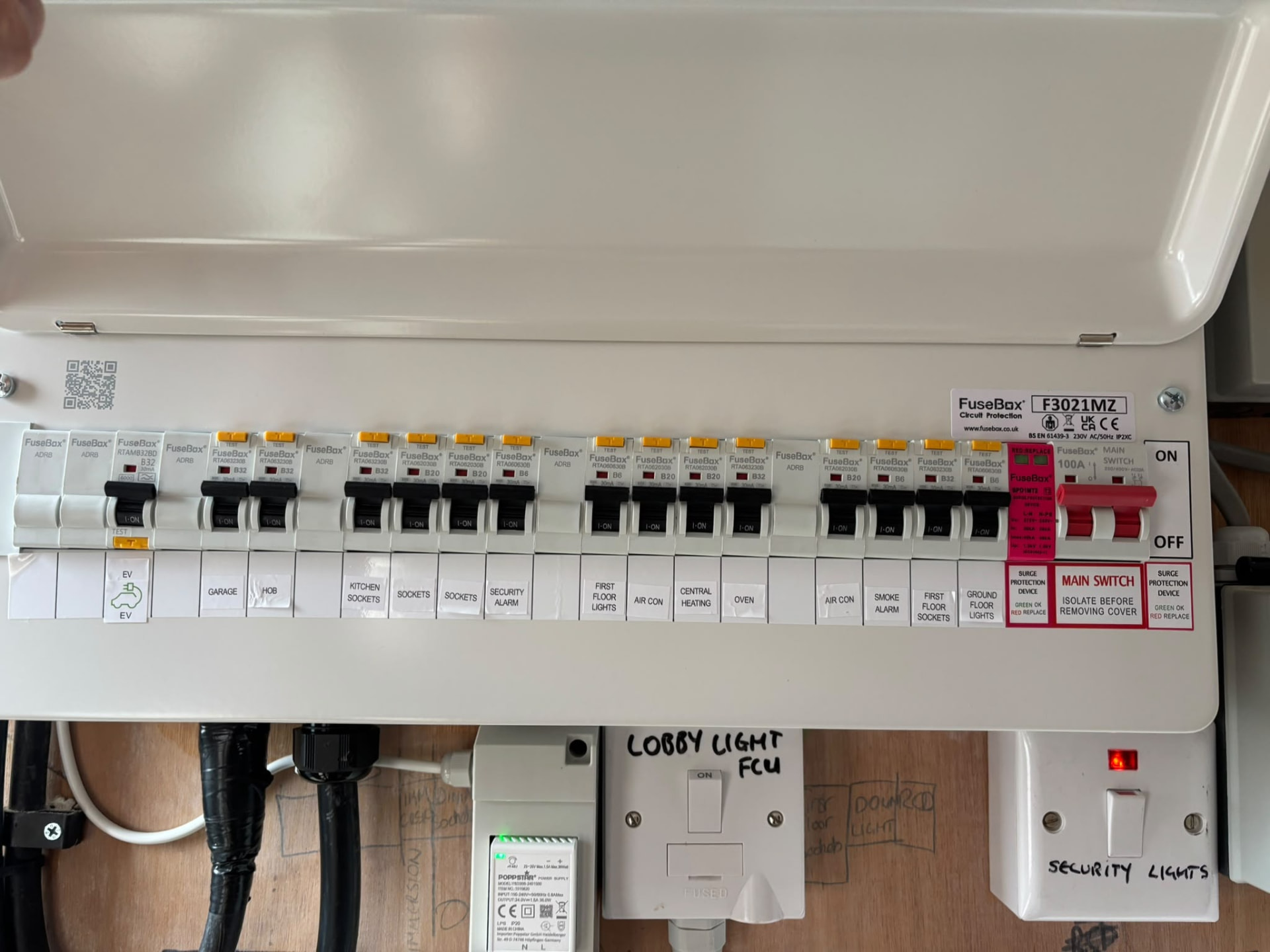
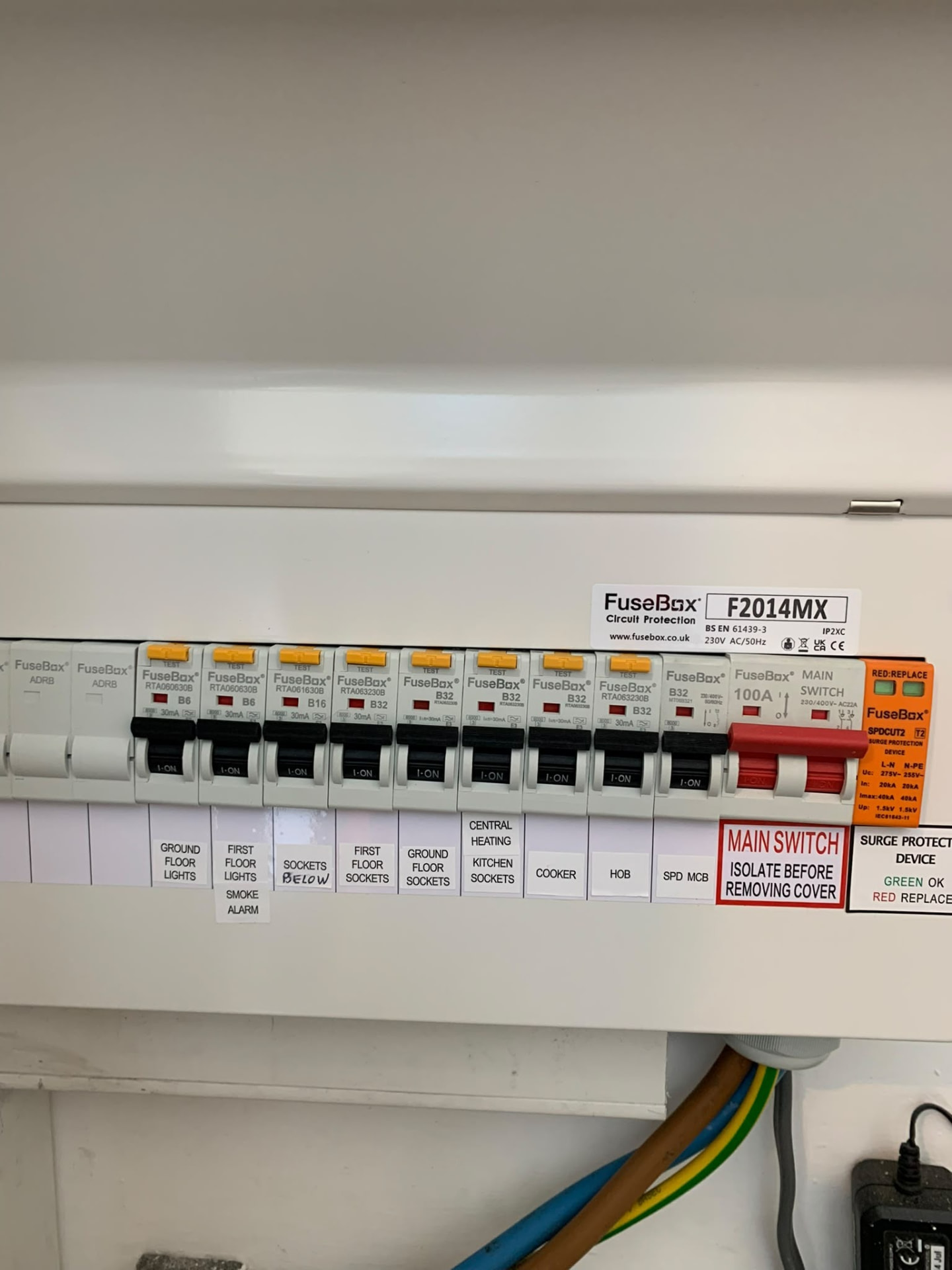
The consumer unit is the control point of the whole installation: it takes the incoming supply and splits it into the circuits that feed your sockets, lights, cooker and shower, protecting each one against overload, short circuit and earth fault. An upgrade replaces the board itself, the protective devices inside it, and brings the earthing and main protective bonding up to current standards at the same time.
Modern boards are metal-clad and use individual RCBOs, which combine overcurrent and residual current protection on a per-circuit basis. That is the practical difference you notice day to day: a failing kettle element trips the kitchen sockets and leaves the lights, the freezer and the rest of the house running.
The work also covers surge protection where appropriate, correct labelling of every circuit so you know what each device does, and full testing of the installation once the board is energised. You are issued with certification for the work on completion.
Mike recommends an EICR before every consumer unit change, charged separately. A new board with sensitive protection will find faults an old fuse board tolerated for years: damp circuits, borrowed neutrals, degraded insulation. Testing first means those are planned and priced, not discovered with your power off.
Homes with a rewireable fuse board
Wooden or plastic boards with rewireable fuses and no RCD offer no protection against electric shock from a damaged cable or faulty appliance.
Houses that trip the whole board
Older split-load boards put many circuits behind one RCD, so a single fault takes out half the house. RCBOs isolate the fault to its own circuit.
Properties after an EICR
Where a report codes the board or its protection as C2, replacing the unit is usually the central item of remedial work.
Before adding major circuits
An EV charger, electric shower or garage supply needs spare ways and adequate protection. A full board is a reason to upgrade now rather than twice.
What it costs to leave it
A fuse board that has worked for forty years feels reliable. What it actually is, is a device that protects the cable, not you. Everything the regulations added since then, it does not do.
Rewireable fuses and old MCB-only boards have no RCD. A nail through a cable, a damaged lead on a lawnmower, or a faulty appliance has nothing that disconnects fast enough.
Plastic boards can and do burn where a connection has loosened and overheated. Metal enclosures are required in domestic installations for that reason.
One RCD covering many circuits means a single fault kills the lights, the freezer and the heating controls at once, usually in the evening.
A common find: fuse carriers rewired with heavier wire than the circuit is rated for, so the fuse no longer protects the cable at all.
A full board means every future job, EV charger, shower, outside supply, starts with a board change anyway, at additional cost and disruption.
An old board is one of the first things flagged on an EICR or a buyer's survey, and it is the item that generates the loudest recommendation.
Our process
An inspection and test of the existing circuits before anything is changed, charged separately, so the condition of what connects to the new board is known.
Board specification, number of ways, protective devices and any bonding upgrades are set out and quoted as a fixed price in advance. No deposit required.
The supply is isolated safely, the old board removed, and the existing circuit conductors identified and prepared for the new unit.
Metal consumer unit fitted with individual RCBO protection per circuit, surge protection where appropriate, and earthing and main bonding brought up to standard.
Circuits tested to 18th Edition standards and brought back on one at a time, with readings recorded and any circuit that fails investigated before it goes live.
Every circuit clearly labelled, certification issued for the work, and the board explained so you know how to reset it and what each device covers.
What you get
Individual RCBO protection means the fault trips its own circuit and the rest of the house carries on working.
Residual current protection disconnects in milliseconds where an old fuse would not have operated at all.
Spare ways and a board sized for the property, so an EV charger, shower or garage supply is a straightforward add-on later.
Clear labelling and per-circuit devices mean a problem is isolated to one circuit in minutes rather than by trial and error.
A modern, certificated board removes a standard recommendation from EICRs and buyer's surveys alike.
Certification issued on completion by a NICEIC Approved Contractor, with £5,000,000 public liability behind the job.
In detail
Consumer unit work looks the same from the outside and differs enormously underneath. What is inside the board, how the supply is earthed, and what state the circuits are in all change the job.
Domestic consumer units are metal-clad, which contains a fault at the board rather than letting it become a fire. The unit is sized in ways, the number of protective devices it can hold, and specified with spare capacity so future circuits do not require another board change.
Position matters as much as specification. The board should remain accessible for isolation and resetting, which is why boxing one into a cupboard behind shelving is a false economy.
An MCB protects against overload and short circuit only. An RCD protects against earth leakage but, on a split-load board, covers a group of circuits together. An RCBO does both jobs on a single circuit, which is why a full-RCBO board is the sensible standard for a domestic upgrade.
Type matters too: circuits feeding equipment with electronic components, such as EV charging, need a device with the correct residual current characteristics. That is specified as part of the quote rather than assumed.
A new board on old earthing is not a complete job. The main earthing conductor is checked and upgraded where undersized, and main protective bonding to incoming gas and water services is verified; these are the conductors that keep metalwork in the property at the same potential during a fault.
This is one of the most common items found missing or undersized on older installations, and it is included as part of an upgrade rather than treated as an extra discovered later.
A rewireable fuse board is a tolerant device. It will happily run a circuit with damp-affected insulation or a shared neutral for years. Fit a full-RCBO board on the same circuits and those faults show up immediately as devices that will not stay in.
Testing beforehand converts that from an emergency on the day into a known list of items, quoted and planned. It also answers the bigger question: if the results show widespread deterioration, the money is better spent on a full house rewire than on a new board feeding tired circuits.
A board change makes sense when the circuits behind it are sound. Where an EICR returns C2 items across most circuits, or the property still runs original rubber-sheathed cable, the board is the smallest part of the problem. In that case a rewire replaces the circuits and the board together, with a 10-year electrical installation certificate on completion.
Domestic consumer unit work in houses, flats and bungalows is the main scope. Light commercial distribution board work is undertaken on request where the installation is of comparable scale and single-phase.
After the upgrade, every circuit is labelled with what it feeds. If a device trips, you can see instantly which circuit is affected, unplug the suspect appliance and reset it. RCD test buttons should be operated periodically to confirm the devices still function.
If a circuit trips repeatedly after a board change, that is the new protection doing its job and identifying a real fault on that circuit; call and it can be investigated properly rather than reset until something gives.
Consumer unit upgrades are carried out across Congleton and the wider Cheshire area, plus Manchester, Stoke-on-Trent, Stockport, Cheadle, Wilmslow, Altrincham and Crewe.
Where we work
Based in Congleton and covering the surrounding towns. See the full list of areas we cover or get in touch.
Related services
Common questions
Anything not covered here, call Mike on 07946 541693.
It is quoted as a fixed price in advance, after the existing board, earthing arrangement and number of circuits have been looked at. Quotes are free and no deposit is required. The recommended EICR is charged separately.
Most domestic board changes are completed in a day, with the power off for a substantial part of it while the unit is swapped and circuits are tested and re-energised one at a time. You will be told what to expect before the work is booked.
Mike recommends one before every consumer unit change. A modern board reveals faults an old fuse board tolerated, and testing first means those are found, quoted and planned rather than discovered with your electricity off. It is charged separately.
For a significant part of the visit, yes. Tell Mike when booking if you work from home or have medical or freezer requirements and the day can be planned around it.
Yes. Certification is issued for the work on completion, with the circuits tested to 18th Edition standards and the results recorded. Certain products and components carry a 12-month manufacturer warranty.
A modern metal board is a long-life component, but the protective devices inside it should be tested periodically; that is part of what an EICR checks. Rented property needs that inspection at least every five years.
Not necessarily. Repeated tripping usually means a real fault on a circuit or in an appliance, and the board is reporting it correctly. Fault-finding call-outs are charged at an hourly rate, quoted before any repair work starts.
Yes. If an EV charger is on the horizon, the board is specified with spare capacity and the correct protection type so the charger installation is straightforward rather than another board change.
A planned upgrade is not, but a damaged, burnt or arcing board is. If you can smell burning or see scorching at the board, switch off at the main switch if it is safe to do so and call Mike straight away.
Yes. Amara Electrical Contractors Ltd is a NICEIC Approved Contractor, registration 041430, with City & Guilds 2391 inspection and testing, 18th Edition, and £5,000,000 public liability insurance.
Next step
Call Mike with a photo or description of your existing board and he will tell you what is involved. Quotes are free, the price is fixed in advance, and no deposit is required.
07946 541693Mon–Fri 8am–7pm · Sat 9am–3pm
Accredited, approved and independently reviewed